The 5 Core Functional Frameworks Behind slander.ai’s Reputation Intelligence System
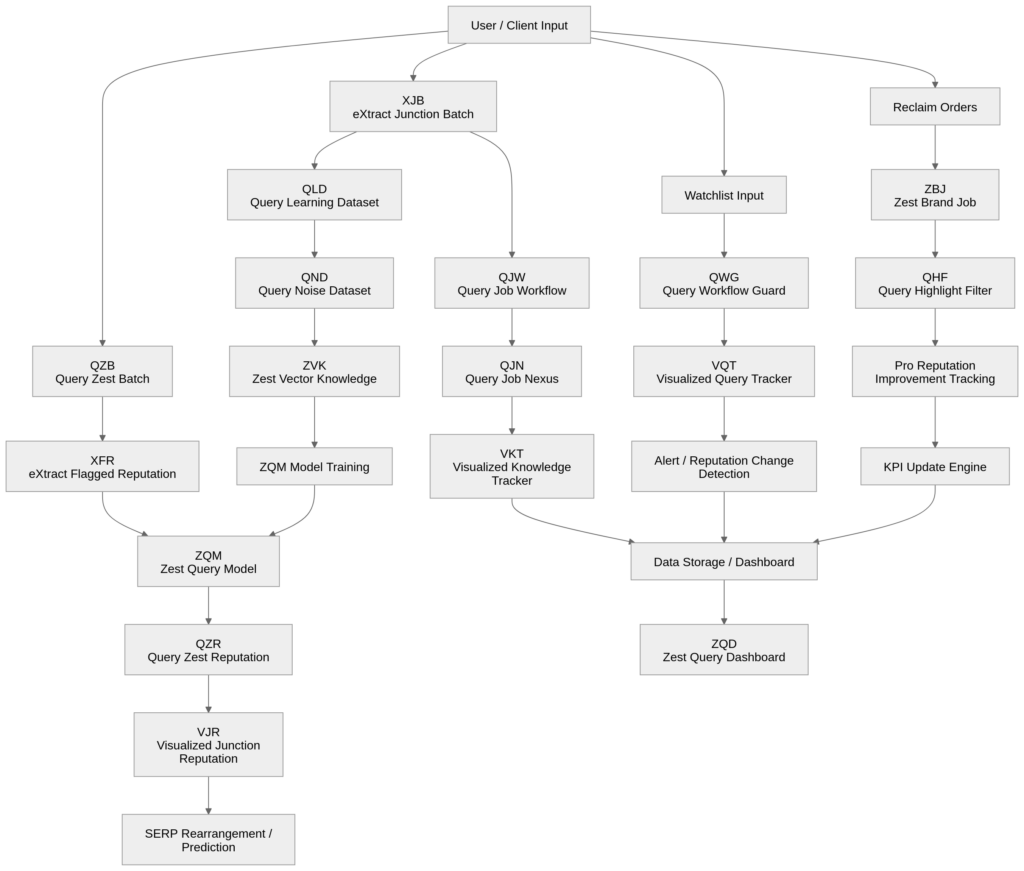
At slander.ai, our platform is built around five core functional frameworks designed to help brands detect, monitor, predict, and recover search reputation risks at scale.
These systems form the backbone of our reputation intelligence workflow, combining AI model training, batch search orchestration, real-time watchlist monitoring, and KPI-driven reclaim execution.
This article provides a structured overview of the five major frameworks and the three-letter functional terminology that powers the platform.
1. Reputation Intelligence Engine
The first and most critical layer is our real-time reputation intelligence engine.
This framework is responsible for:
- SERP retrieval
- sentiment extraction
- reputation scoring
- predictive risk analysis
- result reshaping recommendations
Core terms include:
XFR — eXtract Flagged Reputation
Identifies negative, suspicious, or high-risk search results.
ZQM — Zest Query Model
The AI scoring engine that evaluates query-level reputation signals.
QZR — Query Zest Reputation
Produces the unified reputation score.
VJR — Visualized Junction Reputation
Maps reputation changes into visual dashboard insights.
This layer directly supports prediction and SERP reordering recommendations.
2. AI Training & Learning Framework
The second layer focuses on sample learning and model refinement.
This system continuously improves scoring quality through data-driven training.
QLD — Query Learning Dataset
The core training sample repository.
Includes:
- historical SERP snapshots
- labeled sentiment examples
- reclaim outcomes
- watchlist data
QND — Query Noise Dataset
Separates irrelevant or low-confidence samples.
ZVK — Zest Vector Knowledge
The semantic vector intelligence layer.
Responsible for:
- embeddings
- clustering
- similarity learning
- semantic memory
This framework feeds directly back into ZQM.
3. Batch Search & Data Collection Pipeline
This layer powers large-scale keyword retrieval and crawling.
It is designed for batch execution across large keyword lists.
XJB — eXtract Junction Batch
Entry point for batch keyword processing.
QJW — Query Job Workflow
Workflow orchestration layer.
Manages:
- queue
- processing
- retry
- completion
QJN — Query Job Nexus
Connects crawl, parse, classify, and storage operations.
VKT — Visualized Knowledge Tracker
Tracks batch retrieval results inside the dashboard.
This framework is essential for scalable data acquisition.
4. Watchlist Monitoring Framework
This is one of the most commercially valuable SaaS features.
The watchlist framework provides continuous reputation monitoring.
QWG — Query Workflow Guard
Persistent monitoring layer.
Tracks:
- brand keywords
- founder names
- product terms
- high-risk phrases
VQT — Visualized Query Tracker
Displays trend shifts and anomalies.
Includes:
- ranking movement
- sentiment changes
- new negative mentions
- alert triggers
This layer enables proactive reputation defense.
5. Reclaim & KPI Monitoring Framework
The fifth framework closes the business loop.
This system measures the effectiveness of reputation recovery efforts.
ZBJ — Zest Brand Job
Represents client reclaim orders.
QHF — Query Highlight Filter
Highlights ranking improvements and negative-result suppression.
KPI Update Engine
Updates performance metrics for Pro workflows.
Includes:
- completed orders
- improvement score
- completion rate
- recovery efficiency
This framework turns outcomes into measurable business KPIs.
Unified System Architecture
Together, these five frameworks define the slander.ai operating model:
- Reputation Intelligence
- AI Training
- Batch Collection
- Watchlist Monitoring
- Reclaim KPI Tracking
This architecture enables scalable reputation intelligence across detection, monitoring, and recovery.
Check out our How it Works page or explore the Platform Framework to understand more.