False information about you is spreading online
What to do when inaccurate or misleading content affects your reputation
You search your name — and something is wrong.
The information you see is outdated, misleading, or simply not true.
But it’s already out there.
And once false information appears online, it doesn’t just sit still.
It spreads, gets referenced, and becomes harder to ignore.
This is how reputational damage begins — quietly, but persistently.
Why false information is difficult to fix
Most people assume the solution is simple:
Just remove it.
So they try to:
- Report the content
- Request corrections
- Contact the publisher
Sometimes, it works.
But often, it doesn’t.
Because false information online is not just a single piece of content.
It becomes part of a larger system of visibility.
This is where online reputation management becomes more complex — and more necessary.
How false information gains visibility
False or misleading content doesn’t need to be widely trusted to be visible.
It only needs to be:
- Indexed and referenced
- Reinforced by related content
- Associated with your name or brand
Over time, this creates visibility signals that search systems pick up.
Even weak or inaccurate content can become prominent.
Not because it’s true —
but because it’s connected.
Why correcting it is not enough
Reaching out to correct false information feels like the right move.
But in reality:
- Corrections may not be published
- Updates may not rank
- Original content may continue to dominate
So even if the truth exists, it doesn’t replace what people see.
Because visibility is not determined by accuracy alone.
It’s determined by structure.
A smarter approach to online reputation management
To deal with false information effectively,
you need to go beyond the content itself.
Real online reputation management focuses on:
- Understanding where visibility comes from
- Identifying what reinforces the narrative
- Acting on the factors that shape what people see
Without this, you’re only reacting — not resolving.
Where Slander.ai makes the difference
Slander.ai approaches false information differently.
Instead of focusing only on removal or correction,
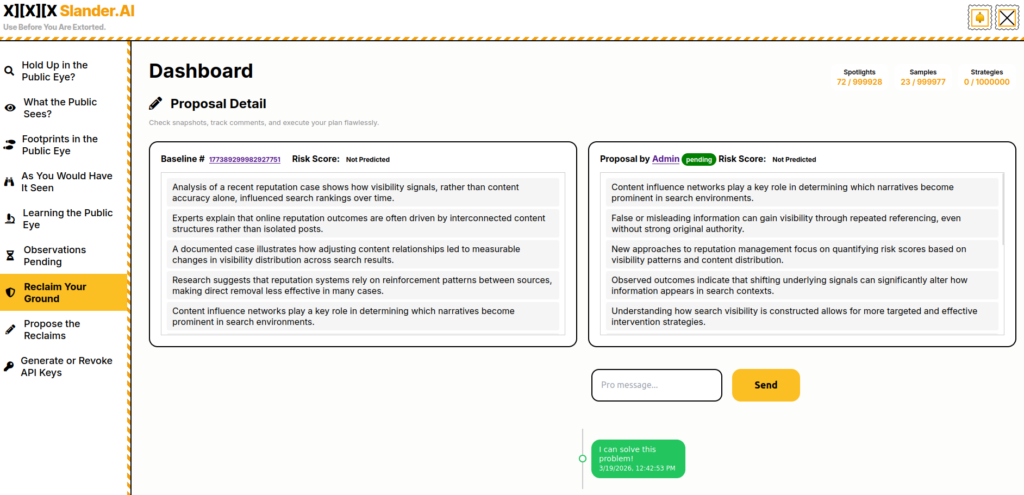
it reveals the underlying structure behind what’s visible.
You get:
- Insight into how the information is spreading
- Clarity on what’s driving visibility
- Access to professionals who know where to intervene
This turns a frustrating situation into a manageable one.
From misinformation to clarity
False information creates confusion — not just for others, but for you.
You see it, but you don’t control it.
That’s the real problem.
Once you understand how visibility works,
you can begin to shift it.
Not by arguing with content —
but by changing what supports it.
See beyond what’s visible
If false information about you is spreading online,
what you see is only part of the picture.
To fix it, you need to understand what’s behind it.
FAQ
What should I do if false information about me appears online?
Start by identifying how the content is spreading and what is reinforcing its visibility. Direct removal is not always possible.
Can false information be removed from search results?
In some cases, yes. But often, managing visibility and influence is more effective than relying on removal alone.
Why does false information rank in search results?
Because search systems rely on signals like relevance, connections, and references — not just accuracy.
Is online reputation management effective against misinformation?
Yes — when it focuses on the underlying factors that determine visibility, not just the content itself.