
How to Evaluate Online Reputation Objectively
Introduction
Most brands believe they understand their online reputation—but few can evaluate it objectively.
Manual checks, scattered metrics, and subjective opinions often lead to inconsistent conclusions. What one team considers “acceptable” may be seen as “high risk” by another.
To make reliable decisions, you need a standardized, data-driven way to evaluate reputation.
With slander.ai, you can turn fragmented signals into a clear, objective evaluation system—enabling consistent analysis, reporting, and decision-making.
If you haven’t yet analyzed risks, start with how to analyze search reputation risk to identify critical issues first.
To understand how all these elements connect, check our complete guide to brand search reputation management.
1. What Does “Objective Evaluation” Mean?
Objective evaluation means assessing your reputation based on:
- Measurable data
- Consistent criteria
- Repeatable processes
Instead of saying:
- “Our reputation looks okay”
You can say:
- “Our reputation score improved by 18% this month”
2. Why Subjective Evaluation Fails
Inconsistent Judgments
Different people interpret the same search results differently.
Lack of Comparability
Without standard metrics, you cannot:
- Compare time periods
- Benchmark performance
- Track improvement
Decision-Making Gaps
Without objective evaluation:
- Priorities are unclear
- Resources are misallocated
3. Key Components of Objective Evaluation
1. Sentiment Score
Measure overall perception using structured scoring.
If you haven’t implemented this yet, learn how to quantify SERP sentiment.
2. Visibility Impact
Evaluate how much influence each result has based on ranking and exposure.
3. Risk Level
Incorporate risk analysis to understand potential impact.
Build this using how to analyze search reputation risk.
4. Trend Direction
Measure whether your reputation is:
- Improving
- Stable
- Declining
4. How slander.ai Enables Objective Evaluation
Unified Scoring System
slander.ai combines:
- Sentiment data
- Ranking influence
- Risk signals
- Historical trends
into a single evaluation framework.
AI-Driven Consistency
Instead of manual judgment, slander.ai uses trained models to ensure:
- Consistent scoring
- Reduced bias
- Scalable evaluation
Standardized Reporting
- Clear dashboards
- Comparable metrics
- Executive-friendly summaries
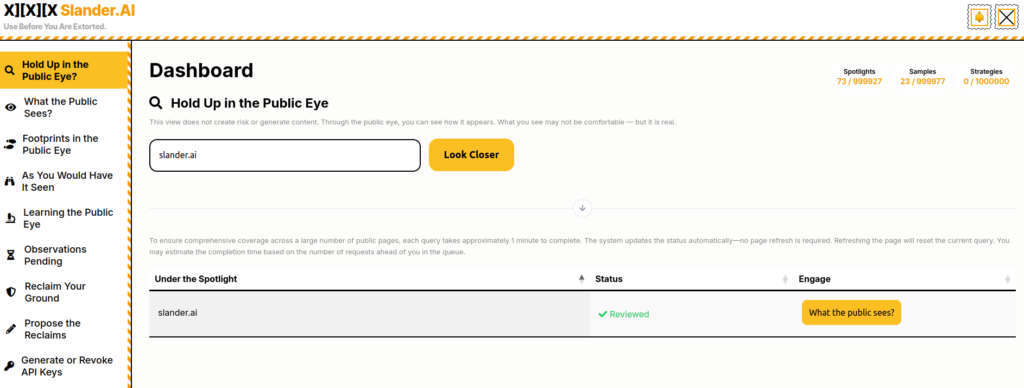
5. Step-by-Step: Building an Evaluation Framework
- Track brand search data
- Quantify sentiment
- Analyze risk levels
- Combine into a unified score
- Monitor trends over time
If you’re still at the monitoring stage, start with how to monitor brand search reputation.
6. Real-World Example
A company previously relied on manual reviews:
- Marketing team: “Reputation is good”
- Support team: “Customers are unhappy”
After implementing structured evaluation:
- Sentiment score: 0.62 → 0.54
- Risk level: Medium → High
Now the company has:
- Clear metrics
- Aligned teams
- Defined priorities
7. Common Mistakes
- Relying on subjective opinions
- Ignoring trend data
- Not combining multiple signals
- Using inconsistent metrics
8. From Evaluation to Decision-Making
Objective evaluation enables:
- KPI tracking
- Executive reporting
- Strategic planning
It transforms reputation management into a measurable business function.
To complete the loop, you should also track reputation changes over time for continuous monitoring.
Conclusion
You cannot manage what you cannot measure consistently.
Objective evaluation transforms reputation from guesswork into a structured system. With slander.ai, you gain clarity, consistency, and control—empowering better decisions across your organization.