
Why Rankings Don’t Reflect Search Reputations (And What Actually Does)
👉 Related Topics:
- How to Evaluate Search Results for a Brand
- How to Measure Search Reputation Over Time
- Why SERP Analysis Is Still Subjective
The Common Assumption: Higher Rankings = Better Reputation
In SEO, success is often reduced to one thing:
👉 Rankings.
If a brand ranks #1 for its name, many assume:
- Visibility is strong
- Reputation is under control
- There’s nothing to worry about
But this assumption is dangerously incomplete.
Because rankings measure position — not perception.
What Rankings Actually Tell You (And What They Don’t)
Rankings answer a very specific question:
Where does a page appear in search results?
They do not answer:
- Is the content positive or negative?
- Does it build trust or damage it?
- Is the source credible or questionable?
👉 In other words:
Rankings show “where” — not “what” or “how”.
When High Rankings Still Signal a Problem
Let’s look at a simple scenario.
A brand searches its name and sees:
- A negative news article
- A complaint forum thread
- A critical blog post
All ranking on page one.
From a ranking perspective:
👉 Everything is “performing well” (top positions)
From a reputation perspective:
👉 This is clearly a risk environment.
What Makes Search Results Harmful (Beyond Rankings)
To understand search reputation, we need to look beyond position and consider:
1. Content Sentiment
Is the content positive, neutral, or negative?
2. Source Authority
Is it coming from a trusted media outlet or an unknown site?
3. Narrative Patterns
Do multiple results reinforce the same message?
4. Visibility Concentration
Are certain types of content dominating the top positions?
👉 These are the signals that actually shape perception.
Why Traditional SEO Tools Fall Short
Popular tools like Ahrefs or SEMrush are excellent at:
- Tracking keyword positions
- Monitoring backlinks
- Estimating traffic
But they are not designed to answer:
👉 “What do these results mean for a brand?”
That interpretation is still left to:
- Manual review
- Subjective judgment
- Individual experience
The Hidden Gap in ORM Workflows
In Online Reputation Management, this creates a major gap.
Teams can:
- Push content up
- Suppress negative pages
But they struggle to answer:
- Is the situation improving overall?
- How risky is the current SERP?
- How does this compare to last month?
👉 Because there is no consistent way to measure it.
Why This Becomes a Scaling Problem
For one brand, manual interpretation might work.
But when you scale to:
- Dozens of brands
- Hundreds of keywords
You run into:
👉 Inconsistency
👉 Subjectivity
👉 Reporting challenges
And eventually:
A lack of confidence in the analysis itself.
A Better Way to Think About Search Results
Instead of treating search results as rankings, we should treat them as:
👉 A system of signals
Each result contributes:
- A tone (positive / negative)
- A level of authority
- A narrative role
When aggregated, these signals form:
👉 A measurable search environment
Many Professionals Are Already Asking This
- How do I know if search results are bad?
- Is there a way to measure search reputation?
- Can SERP quality be evaluated objectively?
The short answer:
👉 Not reliably — at least not with ranking-based approaches alone.
Toward a More Complete Model
To properly evaluate search reputation, we need:
- A way to analyze content, not just position
- A method to aggregate multiple signals
- A framework to produce consistent outputs over time
👉 This is where a structured, signal-based approach becomes essential.
→ Learn more about how a structured approach works
Final Thought
Rankings are still important.
But on their own, they are:
An incomplete metric for understanding search reality.
If we want to move beyond guesswork,
we need to move from:
👉 “Where things rank”
to
👉 “What those rankings actually represent”
About This Perspective
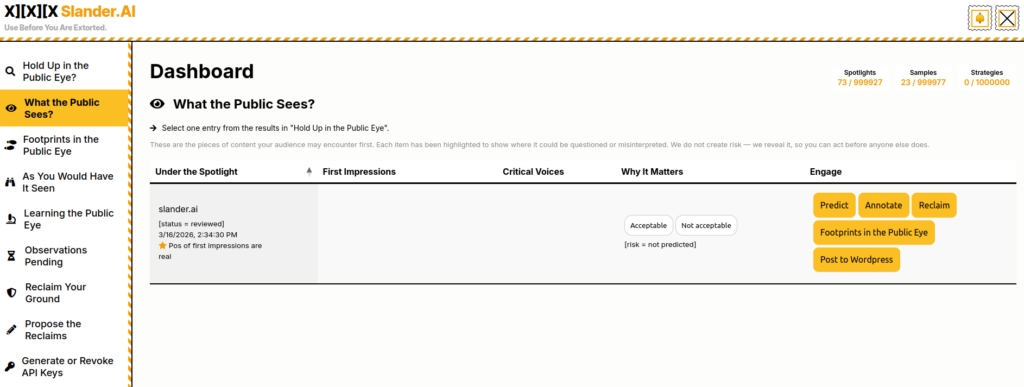
This is exactly the kind of problem we’ve been exploring at Slander.ai —
how to turn fragmented search signals into structured, interpretable insight.
→ Explore real-world applications
→ How to measure search reputation over time?
FAQ
Q: Does ranking #1 mean a brand has a good reputation?
Not necessarily. A top-ranking result could still contain negative or damaging content.
Q: Why are rankings not enough to evaluate search reputation?
Because they only measure position, not sentiment, credibility, or narrative impact.
Q: How can you measure search reputation beyond rankings?
By analyzing patterns across search results, including sentiment, source authority, and recurring narratives.
Q: What is SERP quality?
SERP quality refers to the overall composition of search results — including tone, credibility, and content diversity — not just rankings.